How Safe Is a RIB Boat?
How Safe Is a RIB Boat?
A complete, engineering-based safety guide for owners, buyers, and marine professionals — by Hedia Boat
Rigid Inflatable Boats — better known as RIB boats — have earned a reputation as some of the safest vessels ever engineered. 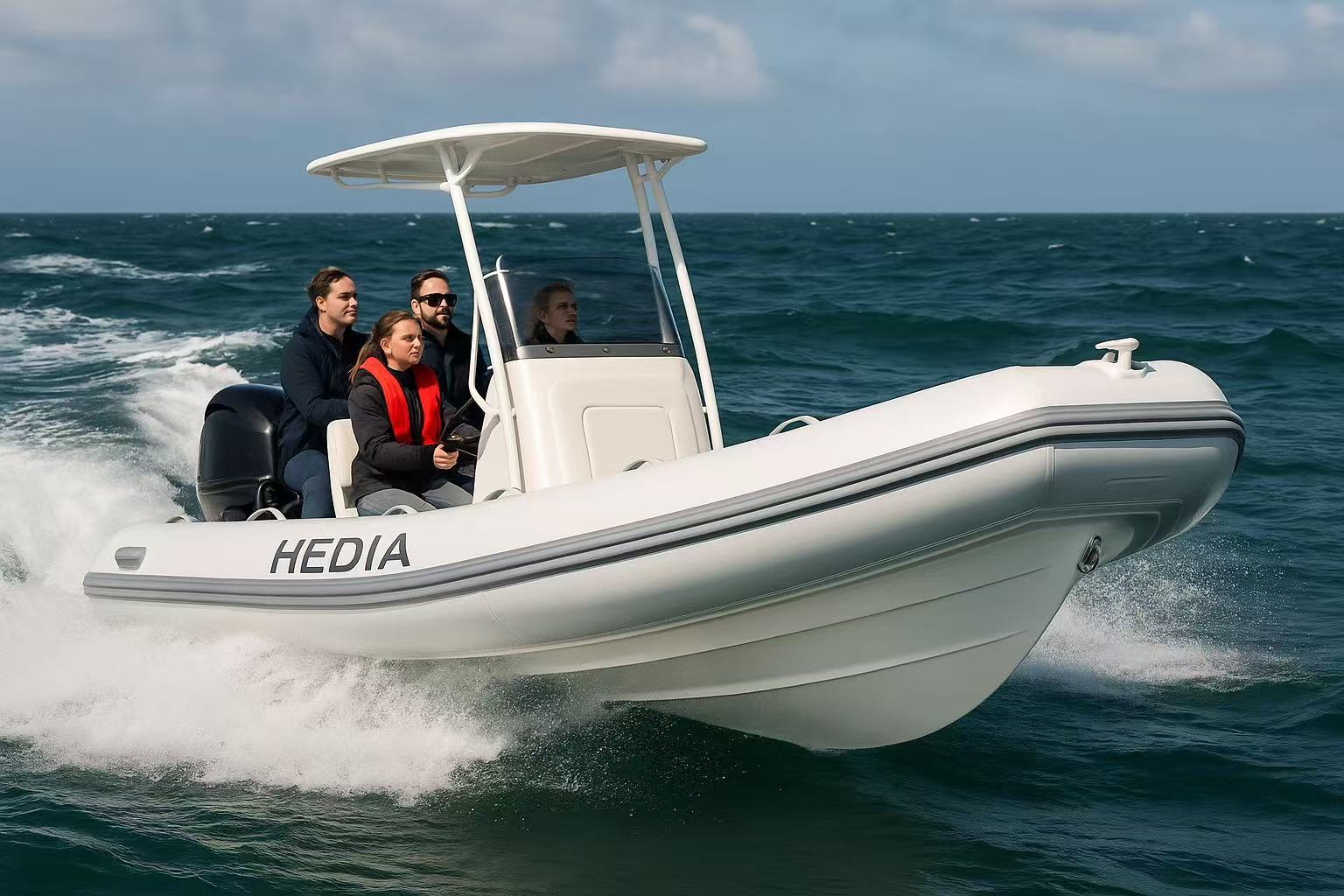 They are used by coast guards, military units, rescue organizations, ocean-race support teams, and professional commercial operators around the world. But why are RIBs considered so safe? And what does that safety look like in real-world conditions?
This deep dive breaks down the science, engineering, and design principles that make a RIB boat one of the most confidence-inspiring craft you can operate — with insights from the way Hedia Boat designs its aluminum RIBs for global conditions.
1. The RIB’s Safety Secret: Dual Structure = Dual Protection
A RIB boat uses two independent buoyancy systems:
1) A rigid hull (aluminum or fiberglass)
• Handles hydrodynamic forces
• Provides directional control
• Enables high-speed stability
• Protects during beaching or impact
2) Inflatable tubes (multi-chambered)
• Add massive buoyancy
• Increase stability
• Absorb side impacts
• Keep boat afloat even if punctured
This dual structure is unique in the marine world.
A RIB will still float, still steer, and still return safely even with one damaged tube chamber — a level of redundancy most vessels don’t have.
2. Industry-Leading Stability: The Physics Behind the Safety
RIBs have a dramatically lower center of gravity than traditional hard-hull boats. This comes from:
• Lightweight tubes placed high on the hull
• Heavy components (engine, fuel, batteries) mounted low
• Wide beam created by the inflatable sponsons
This results in:
✔ Exceptional lateral stability
Passengers can move freely without sudden rolling.
✔ Safe at high speed
RIBs plane early and maintain balance even when trimmed.
✔ Stable during boarding and rescue
The tubes act like wide stabilizing wings.
✔ Predictable turning behavior
The deep-V hull digs in instead of skidding.
For this reason, RIBs are the preferred platform for:
• Coast guards
• Lifeboat organizations
• Police and patrol units
• Offshore regatta teams
• Military fast-response craft
Stability saves lives — and RIBs deliver it naturally.
3. Buoyancy: Why RIBs Are “Virtually Unsinkable”
RIB collars are divided into multiple airtight chambers.
Even if one chamber loses air:
• Remaining chambers support the boat
• The rigid hull maintains shape
• Boat remains controllable
• Passengers stay elevated above waterline
This is why RIB boats are often labeled as “unsinkable platforms.”
A comparable hard-hull boat would take on water dramatically faster.
4. Impact Resistance: A Floating Shock Absorber
The inflatable collars absorb:
• Dock impact
• Hull-to-hull contact
• Wave impact
• Rescue-scenario collisions
A RIB is designed to hit, bounce, and keep going — much like a marine airbag.
For aluminum RIBs (like Hedia), safety is even higher:
• Aluminum flexes under stress instead of cracking
• Resistant to puncture and abrasion
• Better structural integrity after years of use
• Fire-resistant, unlike fiberglass
This is why more professional operators are transitioning from fiberglass to aluminum RIBs.
5. Deck Safety: Thoughtful Design Prevents Accidents
Modern RIB boats integrate self-bailing systems so that:
• Rain
• Spray
• Shipped water
…drains out automatically through scuppers — even when underway.
No electrical pump in the world is more reliable than gravity.
Other deck safety features include:
• Anti-slip EVA or diamond grip flooring
• Deep toerails or tube-top handles
• Reinforced bow boarding areas
• Grab rails at every passenger zone
• Helm positions that maintain 360° visibility
On professional RIBs, even the sharp edges have been engineered out of the design.
6. High-Speed Safety: Control in Rough Conditions
RIBs are not just stable — they are forgiving and predictable at speed:
• Deep-V hull cuts waves instead of slapping
• Tubes reduce rolling during sharp turns
• High freeboard + wide beam keeps spray low
• Weight distribution keeps the bow planted
• Hull chines grip during lateral forces
This makes RIBs incredibly safe in:
• Quartering seas
• Tight turning at speed
• Following seas
• Inexperienced operator scenarios
Even at high speed, a RIB maintains directional authority, which is critical for professional users.
7. What Makes a Hedia RIB Even Safer?
Hedia Boat builds RIBs specifically for harsh, global waters. Key safety engineering includes:
✔ Marine-grade 5083-H116 aluminum hulls
Stronger, lighter, and collision-resistant.
✔ High-volume, multi-chamber tubes
For exceptional buoyancy & roll stability.
✔ Reinforced transoms
Engineered for high horsepower with zero flex.
✔ Self-bailing decks
No risk of flooding in heavy spray.
✔ Ergonomic helm design
Better visibility, better control, safer decisions.
✔ Balanced weight distribution
Predictable behavior under load.
✔ Professional hardware & rigging
Oversized cleats, stainless rails, secure handholds.
✔ CE-compliant safety structure & testing
Every Hedia RIB is built to global standards.
Safety is not a feature at Hedia — it’s a foundation.
8. So How Safe Is a RIB Boat?
In simple terms: one of the safest small vessels ever created.
A well-built RIB boat provides:
• Superior stability
• High buoyancy
• Impact resistance
• Controlled high-speed performance
• Self-draining decks
• Redundancy in emergencies
Add aluminum construction, and you get a platform trusted by the world’s most demanding operators.
Conclusion: RIB Safety Is Engineered, Not Assumed
From lifeboat fleets to recreational families, everyone trusts RIBs for one reason:
they don’t just survive the ocean — they thrive in it.
If you’re looking for maximum safety, durability, and confidence on the water, an aluminum RIB from Hedia Boat is one of the smartest choices you can make.
Strong. Stable. Safe.
Hedia Boat — Make Your Brand Greater.